Collecting Jackie Robinson cards from 1949 centers on early postwar baseball history and the emergence of the modern trading card era. This guide highlights five notable cards connected to Jackie Robinson that enthusiasts consider valuable for historical context and potential value. Each entry features key details, image references, and notable features to help collectors compare condition, rarity, and appeal without focusing on price. Use this overview to inform careful grading, storage, and display decisions for a meaningful collection.
| Product | Year / Series | Notable Feature |
|---|---|---|
| 2015 Trading Card The Jackie Robinson Story #JR7 N L M V P In 1949 | 2015 / The Jackie Robinson Story | Historical reference to 1949 NL MVP era |
| Jackie Robinson Baseball Card (Brooklyn Dodgers) 2001 Upper Deck Legends of New York #16 1949 NL MVP | 2001 / Legends of New York | 1949 NL MVP mention |
| Baseball MLB 2015 Topps Jackie Robinson Story #JR-7 NL MVP in 1949 NM Near Mint | 2015 / Topps Jackie Robinson Story | NL MVP reference; near mint |
| MLB Topps Project 2020 Card 140 | 1952 Jackie Robinson by Tyson Beck | 2020 / Project 2020 | Iconic reinterpretation by Tyson Beck |
| 2025 Donruss #16 Jackie Robinson Brooklyn Dodgers Baseball Card in Raw (NM or Better) Condition | 2025 / Donruss | Recent release with strong collecting appeal |
2015 The Jackie Robinson Story Card JR7

- Features: Jackie Robinson, Jackie Robinson Story
The JR7 card from the Jackie Robinson Story collection connects collectors to the late-1940s milestone era and the first wave of postwar trading cards. Its association with the Jackie Robinson Story makes it a focal point for historical display and narrative-driven collections. Evaluate centering, corner wear, and surface gloss to gauge condition relative to its rarity in similar batches.
Jackie Robinson Baseball Card (Brooklyn Dodgers) 2001 Upper Deck Legends of New York
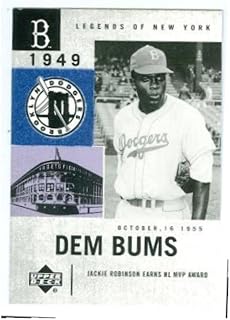
- Brand: Warehouse
- Notable feature: 1949 NL MVP reference
This Upper Deck Legends of New York card ties Jackie Robinson’s 1949 NL MVP year to a broader New York baseball narrative. Collectors should compare print runs, authenticating marks, and any branding quirks from early 2000s Upper Deck releases. The card’s condition and preservation of surface details can greatly influence display value for a modern collection.
Baseball MLB 2015 Topps Jackie Robinson Story JR-7 NL MVP in 1949

- Brand: Topps
- Features: NL MVP reference, 1949 era
Topps’ 2015 Jackie Robinson Story reintroduces a classic moment into a modern packaging and design language. This card is relevant for collectors seeking a bridge between vintage references and contemporary production standards. Priority considerations include card stock finish, protective packaging, and the preservation of sharpness around images and typography to maintain collector interest over time.
MLB Topps Project 2020 Card 140 | 1952 Jackie Robinson by Tyson Beck

- Brand: Toynk Store
- Features: PROJECT 2020, 20 iconic baseball cards; 130 pt stock; protective display case
The Project 2020 reinterpretation by Tyson Beck reflects a modern, artist-driven approach to iconic baseball imagery. This card emphasizes presentation and preservation through its premium stock and encasement. For collectors, this card offers a fresh, stylized perspective on a classic figure, suitable for display in a curated collection alongside vintage cards.
2025 Donruss Jackie Robinson Brooklyn Dodgers Card

- Notable feature: 2025 Donruss release, NM or better
Donruss’ 2025 release places Jackie Robinson within a current hobby framework that emphasizes modern print quality and preservation. This card can complement vintage-inspired collections while offering a contemporary production standard. Consider factors such as print run, overall centering, edge wear, and surface gloss to determine its display and resale potential within a modern baseball card assortment.
Buying Guide
- Condition and grading: For vintage-inspired cards, pay attention to centering, corner wear, surface gloss, and any printing irregularities. Even small flaws can significantly affect value and display quality.
- Authenticity and provenance: Verify branding marks, auto-graphs (if any), and official licenses. For 1949-era references, confirm era-specific features that authenticate the card’s origin and release.
- Rarity and print runs: Compare different print runs and editions to gauge scarcity. Short prints or limited variants often carry greater long-term appeal for collectors.
- Display considerations: Choose protective enclosures, sleeves, and graded slabs for long-term preservation. The Project 2020 card emphasizes encasement, while vintage-minded cards benefit from UV-resistant display cases.
- Display narrative: Build a cohesive display around Jackie Robinson’s 1949 milestones, linking cards to the broader history of baseball and civil rights milestones to maximize storytelling value.
- Investment and risk: Modern reissues may have broader market reach, while vintage-era cards can be more volatile but offer strong historical resonance. Balance narrative interest with market dynamics.
- Storage environment: Maintain stable temperature and humidity; avoid direct sunlight and high humidity to prevent gloss loss, fading, and paper deterioration for vintage stock.
Add a Comment